Potatoes with cheese on top were an all-time favorite at my house. I'm not sure how well leftovers keep, because I don't remember ever having any! We all fought over who got the last spoonful!
What you will need:
Mashed potatoes
Shredded cheese
Butter or margarine
Seasoned salt
Garlic salt
Black pepper
First off, make up a batch of potatoes big enough for the group you're feeding. Homemade or instant, either one, it's up to you. If you've got some leftover mashed potatoes, those will work out fine, as well. This recipe comes in handy when you are trying to figure out what to do with your leftover potatoes after Thanksgiving!
Locate a casserole or baking dish large enough for the potatoes to cover the bottom and be about 1 1/2 to 2 inches thick.
Dot the top of the potatoes with butter. You don't need a lot, just enough to cover the surface of the potatoes with a thin layer of butter. This helps to moisten the potatoes, and to dissolve the salt in the seasonings. Sprinkle with garlic salt, seasoned salt and black pepper to taste. Top with shredded cheese.
Bake uncovered in a 350 degree oven until cheese is melted and bubbly. Serve immediately.
At my house we have a backyard full of farm animals. We've got goats, chickens, and ducks. While the goats do little to earn their keep (unless destroying anything they can fit in their mouth counts,) the ducks and chickens actually provide something useful: eggs! Eggs from your backyard are the best eggs ever! Especially if you allow your birds to free range. Our birds have the run of the yard. The chickens scratch and peck, and find bugs and seeds to dine upon, while the ducks eat the bugs that have drowned in their pool, or that are hiding under the plants that they graze on. I introduced my ducks to grass when they were just little yellow ducklings, so now they really love to munch on it! It is a smart idea to set up a designated area for your birds to make a nest and lay their eggs, otherwise it will be Easter egg hunting on a daily basis. It has been a challenge for me to find a box that the chickens will lay eggs in, but that won't get stomped into oblivion by curious goats. Recently I found a sturdy egg crate at a local thrift shop. I'm hoping that this will be my solution! Check for eggs every day. Take them inside and out of the heat or cold. I typically wash my eggs every few days. I let a nice pile build up in my egg basket, then wash the whole batch. Since eggs have a coating on the outside which keeps them protected from germs and bacteria, it is okay to leave them at room temperature for a few days, or even as long as a month, if they are kept in a cool, dark location. Washing your eggs washes away this coating, therefore your clean eggs should be kept in the fridge to protect against illness.
The tools of the trade.
When you have a stack of eggs ready to wash, gather up some egg cartons, a clean damp towel, and a spray bottle with a dilute bleach and water solution. Rub your eggs just enough to remove any dirt or debris from the outside (feathers, straw, mud, manure, etc.) Don't scrub the whole egg top to bottom. You want to keep as much of the protective coating in place as possible.
See the weak spot at the top?
As you are wiping your eggs off, watch for cracks or weak spots. A dark spot on the shell of an egg is typically an indicator of a crack or weakness. Press gently with your thumb and listen for the crack. If you hear or see your egg crack, discard it.
Ready to be spritzed!
Once your eggs are all inspected and wiped, lay them out on the counter and give them a good spritz with your bleach solution. Roll them around and spritz from another side, just to be sure you get even coverage.
Thirty good-looking eggs!
After your eggs are washed and spritzed, they can go into an egg carton, or flat, and be put in your refrigerator. If you have more than one carton, number them so that you know which carton to use first. This way, you can use up the older eggs before they go bad.
If you would like, you can weigh and label your chicken eggs for the purpose of cooking or baking. I use a kitchen scale, set to weigh in grams, to weigh my eggs, and write the size on the bottom of the egg with pencil. Weighing in grams seems to be a bit more accurate. The sizes of chicken eggs are as follows:
Jumbo - Greater than 71 grams
Extra Large - Greater than 64 grams
Large- Greater than 57 grams
Medium - Greater than 50
Small - Greater than 43 grams
Peewee - Greater than 35 grams
L-R: The smallest chicken egg, largest chicken egg, smallest
duck egg, and largest duck egg in my basket.
Duck eggs are larger than chicken eggs, typically weighing as much as, or more than, a jumbo chicken egg.
Merle the duck's giant, monstrous, jumbo-sized egg.
Duck eggs are also higher in cholesterol, and have a higher yolk to white ratio, which makes them quite tasty. All the bad stuff tastes so good, right?
Treat your duck eggs much as you would chicken eggs. Be sure to cook your duck eggs thoroughly, though, as there may be an increased chance of salmonella associated with them. Also, keep duck eggs away from ready to eat food items, and wash your hands after handling them, for the same reason. Don't want to scare you away, just giving you the facts!
See the itty-bitty fairy egg?
On occasion, a bird will lay an egg smaller than a peewee egg. This is commonly referred to as a fairy egg, and is typically not a complete egg. It is sort of a random event, but occurs more frequently in new layers, or in older birds who are ending their laying career.
I wanted to purchase some fruit to chop up and freeze for smoothies, and this little melon was one of my selections! I figured, after I brought it home, that it would also afford me the opportunity to show you how to save melon seeds. As discussed in my Finding Seeds to Plant post, watermelon seeds are pretty easy to save. Eat the watermelon, spit out the seeds, wash them and let them dry. Other types of melon are pretty dang easy, too! Most melons resemble squash and pumpkins in how their seeds are situated, so you just need to scrape out their "guts" to get to the seeds! First off, gather together your tools: a cutting board, a sharp knife, a spoon, a mesh sieve, a small bowl, and some paper towels.
Cut your melon in half, then use your spoon to scrape out the guts. After I scraped out my melon I put my guts into a bowl and used my spoon to separate the seeds from the guts.
I peeled and chopped up the fruit, putting the fruit in the freezer and flinging the rinds out for the animals to eat. The chickens peck the fruit off, then the goats eat the rinds. The ducks are clueless about food flung out the door. They do not realize what they are missing out on.
Once you have your seeds and guts thoroughly separated (it's okay if a little fruit matter gets in) put them into your sieve and rinse thoroughly under cold water. Make sure you rinse away all of the sugar and pick out any remnants of the guts. A sticky seed is an unhappy seed, and may turn into a rotten seed.
Lay your newly washed seeds out on some paper towels and allow them to dry completely. Store in an envelope or zip top bag to plant next year. I always mark my seed receptacle with the date, and the type of seed, so that there is no confusion on what it is or how long it will last.
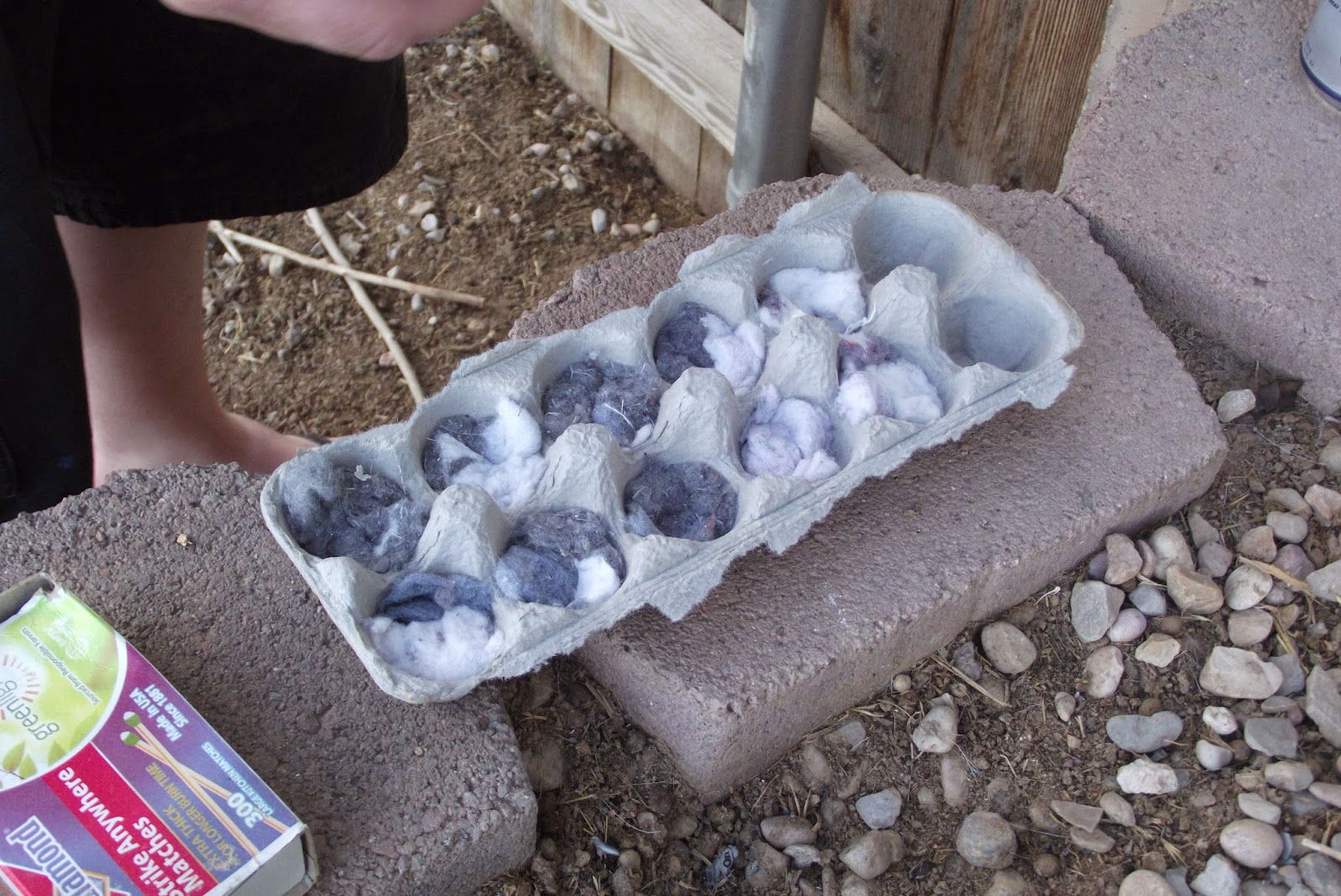
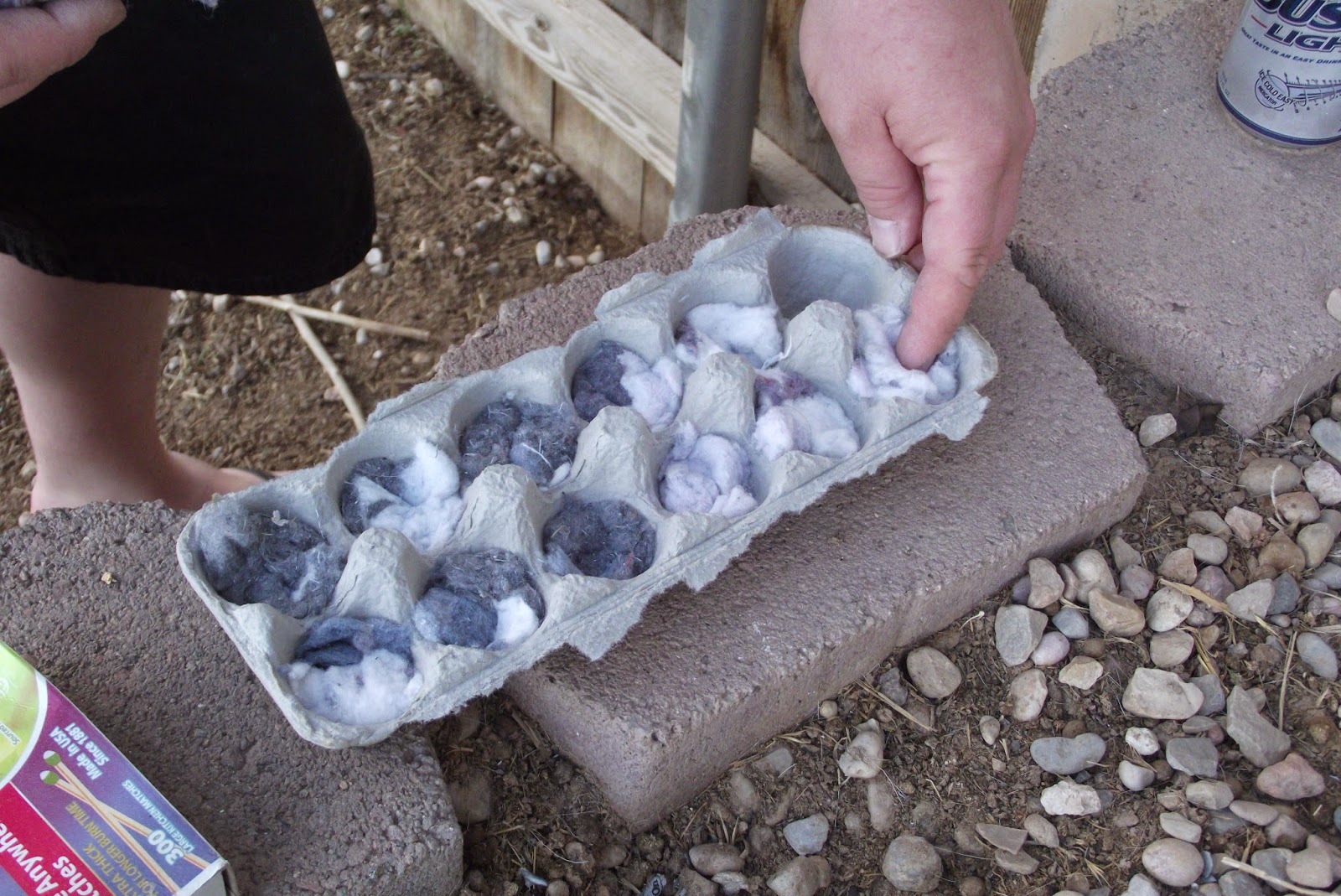
We will teach you how to make your own fire starters for lighting fires in your fireplace, backyard fire pit, or while you are out camping or on the beach. Hey are small, portable, cheap, and actually work really well! You can light a fire without using paper, cardboard, or even kindling! I would recommend this project to be an outdoor endeavor, as you are dealing with heat, flammable substances, and the potential for a big mess. Also, please keep children away due to the risk of burning injuries.
Here's what you will need:
Dryer lint
Paper egg carton
Paraffin wax, or some old candles An old cooking pot or other metal vessel to melt wax in
A heat source for melting the wax
We shooed the goats away and lit a fire in Willie's camp stove. Next we tore the lid and flap of of the egg carton. Each of the egg cups was then filled with the dryer lint.
We used an old cooking pot to melt down our wax.
Once the wax is melted and watery, pour it into the lint filled egg cups. Allow to cool completely. After the wax has cooled and solidified, rip or cut the cups apart. Each of these little units can be used as a fire starter.
You will notice in the photo that a few of the cups are filled with green wax. We tested out melted down crayons as a potential source of wax, but the wax is much too thick for this application.
Check out the demonstration video to see a fire starter get a blaze going in about 5 minutes!
Shaggy has always been the best goat! Before we brought him to our house his name was Mercury and he was the pet of Dan the goat man's wife, Gloria. Dan told Willie that he would sell him Mercury and Mercury's friend (we would name her Ronnie) but that his wife would cry when she found out. Sure enough, Gloria was sad to see him go, and asked that she be able to visit him if she wanted. We agreed wholeheartedly! Little Mercury came to our house and we decided to name him Shaggy, short for Shagrath, the lead singer for Dimmu Borgir. His friend came with him, and we named her Ronnie, after Ronnie James Dio. They were the best of friends!
Tallest Goat Shaggy
Shaggy, taste testing my new garden hoe.
We had a lot of fun learning about how to take care of our new little friends. They would run and jump and climb all over! Their favorite games to play were Tallest Goat (who could get to the highest point possible and maintain their position there) Chase the Goat, and Chase the Human. Once we played a game of Chase the Human, and the goats hid in the goat house and ambushed me when I went to find them. They also chewed on everything, which we thought was very cute at the time, little did we know just how much they loved to chew. After the new year we got money back on our tax returns, and we decided to go back to Dan the goat man's house. When Willie had gone to pick out Shaggy and Ronnie he was able to hold a brand new, newborn little goat. He thought it was the cutest thing ever! Turns out, it was Shaggy's sister, Frankie. When we went to Dan's house, she was ready to go home. We brought her home and named her Dani (after Dani Filth, of Cradle of Filth.)
We had brought Dani home to keep Shaggy company, because Ronnie was pregnant and soon would be giving a lot of attention to her new babies. We didn't want Shaggy to be lonely without the attention of his friend! At first we were a bit disappointed, as both Shaggy and Ronnie were mean to little Dani, and I had to "come to her rescue" several times whens he was stuck out in the rain because they wouldn't let her in the house.
Dani dominating her brother.
Shaggy demonstrating how hungry he is.
I sent this to my friend to convince her to
sell me home hay!
Eventually, Shaggy started to slow down a bit, taking longer naps, not running around a lot, just acting like he didn't feel good. I took him to the vet, and the vet treated him for an infection (he suspected it because of a higher than normal temperature) and hoof rot. I told him about Shaggy's recent laziness and lethargy, and although the subject of CAE came up, he said he had never seen any clinical signs in any goats he had ever treated. Since Shaggy didn't have any signs, other than slowing down and being lethargic, we dismissed the possibility of a CAE infection. (On a side note, CAE stands for Caprine Arthritis Encephalitis and is a retrovirus which causes chronic, progressive arthritis and weight loss in adult goats. Once of the easiest to identify signs is swollen knees on the front legs, in addition to the weight loss, lethargy, and signs of painful joints.) Shaggy came home, I learned how to administer shots, and he seemed to perk up a bit.
Once the babies were born, Shaggy and Dani had become pretty good friends. Shaggy was very good with the little baby goats, Toki (after Toki Wartooth of Metalocalypse) and Jezebel (after Sarah Jezebel Deva of Cradle of Filth) while Dani headbutted them, he was very nice to them and very gentle. He taught baby Toki how to fight like a goat!
Shaggy waiting to go home after his medicine.
Around the time that we were contemplating weaning the baby goats is when Shaggy's next health trial came about. We noticed his eye was watering and red, and when we came in close to examine this, noticed that he also had a big bump on his jaw on the other side of his face. Willie called a few vet's offices and found one that could see him the very next day. So, off we went! Shaggy and I went to see the vet, and have him examined. His watery eye was caused by a scratched cornea, and the bump was a piece of grain that had wedged between his teeth and worked its way out through the bottom of his jaw. Treatment for the eye was straight-forward, we just had to apply two types of ointment twice a day.The abscess, however, was much more difficult, and it broke my heart. Twice a day we would have to smoosh the infection out of it, and flush it with surgical soap. While we were smooshing, Shaggy was crying like a baby goat! To top it all off, he had to have a round of penicillin shots as well. Poor little guy! During the treatment process, Willie had to go out of town for work. We was worried about his little buddy, but I promised to take good care of him. It was also during this time that the baby goats had to be weaned, so Ronnie went on a month-long vacation to Dan's house. Little Shaggy was a sad fellow. His eye and his jaw hurt, and he didn't have his buddy Willie, or his buddy Ronnie, just mean ole Chuck who gave him shots and smooshed his face. Once a month had passed, Willie had come back, and I went over to Dan's house to pick up Ronnie. He was so excited to see his buddy Ronnie! He loved her so much! All he wanted to do was put his head on her, and fight. (That's what goats do, they fight!)
Shaggy's resting pose.
Shaggy continued to slow down and act uncomfortable, and soon I began noticing that his knees were getting big. I knew what was causing it, but didn't want to admit it. I talked to Willie about taking him to get tested for CAE, but it was put off for a while because we were afraid that it would confirm what we already knew. Shaggy would find a comfortable spot in the yard to lay down, nap, and chew his cud, and his friends would all come out to visit him at different times. They would come out and nuzzle him, then go about their business. Any time they saw Shaggy eating a tasty weed or chewing on a good-looking branch, they went to investigate. Shaggy could pick out the best weeds and sticks, so they knew that wherever he was, he was munching on tasty stuff. Pretty soon we made an appointment to get Shaggy tested. While we waited for the vet to do some research on testing facilities and prices, Shaggy's feet started hurting him. Since the floor was concrete, he didn't want to lay down and rest his feet, so he just danced around. I felt bad for my friend, so I picked him up and put him in my lap. When the doc came back in, he looked at me pretty funny. Here's this woman sitting in the exam room with a miniature goat in her lap. I didn't care, friends help friends, and I wanted to help Shaggy. Sure enough, the results came back positive, and although there wasn't much to be done about it, at least we knew for sure what we were dealing with. We decided that we would look out for Shaggy and make sure he got all the best for the rest of his life. Whenever the goats got treats, we made sure that Shaggy got plenty too. We made sure that Shaggy got lots of ear scratches and tail scratches. Whenever we were hanging out on the porch or made a campfire, Shaggy got to sit in my lap and hang out too. During games of Chase the Goat, we made sure that we played with Shaggy too. He couldn't run like the other goats, but he would trot around and kick, and when we "caught him" he would jump and throw his head around and just be happy. We decided that as long as he was happy, we wouldn't put him down. Shaggy got to do a lot of things that the other goats didn't but we wanted to make him an extra happy goat.
Shaggy helping me cut down weeds.
When I went weed getting at the neighbor's house, Shaggy came with me so that he could munch on weeds while I chopped others down. All the pollen from the weeds made his allergies act up, and he wound up with a cough. I kept an eye on him, checking his lungs and his temperature, just in case it turned into something more serious. One morning I came out to find that his nose was running, his cough was worse, and upon checking his temperature I found it to be elevated. Shaggy was sick. I felt awful. Willie had just gone out of town again for work, and it would be nearly two weeks before he returned. I knew that when I told him his friend was sick, he would be very worried. I relocated Shaggy to the front yard where he could eat plenty of grass and greens, and get a rest from the dust and the other animals. I knew that I would have to give him penicillin shots, and that they would be especially painful for him because he had grown so thin. I sat in the grass, put him in my lap and just cried and apologized.
Eating his own pile of grain! Yum!
For the next few days I took him out to the front yard to graze and eat grain, and be away from the others when I gave him his shot and his cough medicine, so that they wouldn't bully him while I had him restrained. He got kind of lonely out there by himself, so I brought his friend Toki out to be with him and encourage him to eat. Over the next little while he seemed to be feeling better, although now he was painfully thin and still not eating well.
Shaggy and his friend Toki eating together
in the front yard. This is the last picture I
took of Shaggy.
I picked Willie up at the airport on Monday evening, and shortly after dark we went outside to barbecue up some dinner. It occurred to me that Willie hadn't seen his buddy Shaggy yet, so I goat-napped him! I went out to the goat house, scooped him up and carried him out front to hang out with us. He stayed for a few minutes, ate some weeds and chewed on some things that we would rather he not have chewed on, but he seemed really tired. We gave him some scratches, and Willie told me I should take him back so that he could go to bed. The next day I had to work early in the morning, so Willie would have to feed the goats before he went to work. The nurse called me on my radio and told me that my husband was on the phone, which had never happened before. I was concerned. When I picked the phone up, Willie was very upset. He told me that Shaggy had passed away, and that he had to go to work for a mandatory meeting. He didn't know what to do. I told him I would come home on my break and start preparations to bury our friend. I went home, took his collar and tag off and broke down crying. I had kept it together at work, but this was really hard. I found the shovel, located a good spot, and started digging. After I finished the rest of my shift at work I came home and continued digging. I took a break to sit and rest, and to be sad, and Dani came over to be my friend. The goats were all very quiet and solemn, as though they knew their friend was gone. I buried him in the corner of the yard. That night Willie came home and we lit a campfire and hung out with the goats. Just as the sun was going down Ronnie called for all the goats to come home, because it was getting dark. Everyone was there except for Shaggy. All the goats looked around for a few minutes, as though they expected him to show up so that they could all go to bed. Willie told me that when he went out to feed the animals, all the goats were hanging out in the house with their friend. When they came outside to eat, Willie found Shaggy. Although his body was cold, there were little warm spots where his friends had been cuddling him. Everyone loved Shaggy, and everyone misses him.
Like any living creatures, goats need food, water and shelter. They are relatively easy to keep, but do require a bit of maintenance.
Food
Our home-made hay manger
Goats are browsers, so they should have access to a wide variety of plant matter in order to stay healthy. Goats will munch on grass, weeds, leaves, twigs, and bark. If these items are in short supply or winter snow has covered them, hay should be provided. It is also a good idea to have some grain for those little fellows to nibble on. A little goes a long way, so watch your portions! Over feeding grain will cause your goats to become overweight (like mine.) Especially at risk for grain-induced obesity are wethered bucks and does which are not pregnant or in milk. My dry doe and her wether son tend to hog more than their fair share of grain and, therefore, are quite fat indeed. I wonder if they would go jogging? They certainly need it.
Well-used salt block
Some type of mineral should also be provided, either in the form of a salt block or in a granulated form mixed with grain. Goats benefit from mineral mixes that are high in copper. Take care if you are keeping your goats with sheep or other forms of livestock, though. Too much copper can kill sheep. Always feed goats from a bin, bowl or trough. Eating grain off of the ground can increase worm infestation, and may lead to coccidosis, which may be lethal.
Water
Our raised trough
Goats need access to clean water at all times. Goats will not drink dirty water, and can become dehydrated as a result. If keeping your goats with any type of waterfowl (ducks, geese, etc) be sure to raise your water troughs off the ground a bit to discourage bathing in them. One method that we use is to put your trough on top of an old tire.
Shelter
The goats' and birds' mansion
Goats need a spot to get out of the rain, snow, wind and sun. It doesn't need to be a fancy or particularly large structure, just has to have a roof and at least three walls. Our goats are spoiled. They have a two-room house that they share with the birds, windows, a shingle roof, and a covered porch.
Hooves
Since hooves are continually growing, they need to be checked and trimmed on a regular basis. I like to try to trim hooves every month or two, but check the hooves and feet every week or so for length, soundness, injuries, or signs of rot. Hoof root can occur when feet are not kept trimmed and clean. A sharp pair of garden shears (with narrow blades) and a drywall rasp will do well for trimming and shaping goat hooves. I will be posting an article on trimming hooves, so please be sure to check back later for more detailed information!
Worms
All goats have worms. Although it is impossible to eliminate worms entirely, steps should be taken to keep their numbers as low as possible. Worm your goats on a regular basis, but step up your efforts during the springtime, or when stress levels are high (moved to another area, added new goat to herd, change in diet.) Worming medication comes in an oral suspension, an injectable, or in pelleted forms. You can choose which method you prefer, but try to change it up periodically so that the worms don't build a resistance. If you need help on the subject, I hope to write an article in the future on how to administer worming medication. In the meantime, check with a goat breeder or livestock veterinarian if you have any questions on administration or dosages.
Vaccinations
Your goats will need a CDT shot annually. Their first shot can be administered after they are about 8 weeks of age. Please check back frequently, as I hope to write an article in the future on giving injections to goats. When in doubt, seek out an experienced hand. Either from a veterinarian, or a trusted goat breeder.
Goat-Proofing
Goat-proofed peach tree
Goats explore with their mouths, and will chew anything that they can fit in their mouths. As a result, great care must be taken when deciding which items are appropriate to keep within access of goats. So far, our goats have eaten the wiring for our sprinkler timer, torn apart and broken plastic flower pots, torn up weed blocking plastic sheeting under the gravel in the back yard, eaten the wiring and igniter switch on a barbecue grill, and are currently working on stripping the bark off of one of our trees. They also eat any piece of paper or plastic bag that happens to blow into their territory. The only thing that seems to deter goats from doing whatever it is that they are doing, that they know they shouldn't be doing (like eating chicken feed, or climbing up on the back porch,) is spraying them with the hose. Getting wet is very low on their list of preferred activities.
These were a cheap and easy way to feed the family in the mornings when there wasn't school. The best part? Two ingredients, unless you count the fryer oil.
What you will need:
A package of refrigerated biscuit dough (the smaller biscuits, not the jumbo)
Sugar
A vessel for frying (deep fryer, or cast iron pan)
Enough cooking oil to cover the bottom of your vessel by at least an inch.
A shallow dish or bowl
A paper towel-lined retrieval plate
Tongs, or some other donut retrieval device
Heat the oil in your vessel over medium-low heat. Pour some sugar into your shallow dish. Place paper tells on retrieval plate. Once all this is done you can pop open your biscuits. Pull out your biscuits and put a hole through the center with your thumb. Stretch the dough out a bit (pinching, rather than pulling helps the biscuits to not break apart) until it resembles a skinny version of the donut it will soon become.
Place each donut into your heated oil carefully. Monitor carefully, and when the bottom side is golden brown, turn the donut over carefully with your tongs. One the second half of your donut is golden and delicious, remove to your retrieval plate to drain a bit. Allow the donuts to cool just long enough that you can easily handle them.
Take each donut and press each side gently into the sugar. You could also add some cinnamon into your sugar, but I prefer the original!
 Potatoes with cheese on top were an all-time favorite at my house. I'm not sure how well leftovers keep, because I don't remember ever having any! We all fought over who got the last spoonful!